2026 MODEL YEAR
Trade Wind 23FB
Overview
Sleeps up to 4, Front Primary Bed, Rear-Spanning Shower and Lavvy, Convertible U-Seated Dinette, Fully Inverted Electric System
Gallery
10 photosFloor plan
Tap a numbered point to see what's where. Zones placed against the official 23FB diagram.
- 1Front primary bed — Walk-around front queen at the nose of the coach.
- 2Wardrobe — Hanging wardrobe and dresser just aft of the bed.
- 3Cooktop — Three-burner cooktop on the street-side galley run.
- 4Galley & sink — Stainless sink, counter and fridge — the kitchen sits opposite the lounge.
- 5Dinette & lounge — Curb-side convertible dinette across the aisle from the galley — the daytime living zone.
- 6Shower — Full-width rear bath — shower on the curb side.
- 7Toilet & lav — Toilet and vanity sink share the rear wet bath spanning the back wall.
Specifications
Weight
Size
Tanks
Camping
Fit check
Height includes rooftop A/C - without A/C the trailer is roughly 2–3" shorter. Always measure your specific unit before a tight clearance.
Total rig length: about 43 ft with a typical tow vehicle (~19 ft) - plus 2–3 ft for the hitch gap. Always confirm site dimensions with the campground before booking.
Full specificationsSecondary specs - solar, battery, interior height and more
- Single-axle trailers are lighter and easier to maneuver; dual-axle adds stability for larger, heavier models.Axle
- Dual axle
- Standing headroom inside with A/C unit - measured at the tallest point.Interior height
- 6' 6.5" (with A/C)
- Factory rooftop solar panel wattage for charging the house battery off-grid.Solar
- 500 W (standard)
- House battery capacity in kilowatt-hours - powers lights, outlets, and appliances.Battery
- 10.3 kWh
- An editorial 0–100 composite from this site - battery kWh, solar watts, and tank sizes vs. the lineup. Tiers: Strong (75+), Moderate (55–74), Basic (<55). Not an official Airstream rating.Off-grid score
- Strong
Towing
Your tow vehicle must be rated for at least 6,500 lb - the official fully-loaded GVWR. Official hitch (tongue) weight is 600 lb (~9% of GVWR).
Can your vehicle tow it?
Checks this floorplan's loaded weight (6,500 lb GVWR) against a tow vehicle's three real limits - tow rating, payload, and combined weight (GCWR). Pick your vehicle:
Ratings shown for Chevrolet Silverado 1500 - Crew Cab 4×4 · 5.3L V8 · Max Trailering Package (NHT). Your door-jamb certification label wins over any number here.
Good margin on every limit. Binds on combined weight (gcwr) at 73%.
Modeled config: Crew Cab 4×4 · 5.3L V8 · Max Trailering Package (NHT). source 1 · source 2
How this is calculated
Three checks against one stated configuration of the tow vehicle. Max tow, payload, and curb weight are manufacturer-published; GCWR is published where available and otherwise a derived planning value (curb + max tow + 300 lb - not an official published GCWR, see below).
- Trailer tow rating - the trailer at its loaded weight (GVWR, not dry) vs. the truck's max tow rating.
- Payload - loaded tongue weight (modeled at 13% of trailer GVWR, the mid of the 10–15% rule) plus people & gear in the cab vs. the truck's payload.
- Combined weight (GCWR) - truck + trailer + everything vs. the gross combined weight rating. GCWR honesty note: where a manufacturer publishes a GCWR we use it; where it does not, the dataset carries a derived planning value (curb weight + max tow + 300 lb, the SAE J2807 basis) - not an official published GCWR for that configuration.
The verdict is the worst of the three: ≤80% of a limit is comfortable, 80–100% is tight, over 100% exceeds it. Manufacturers' "max tow" and "max payload" usually come from different configurations and are mutually exclusive, so each vehicle here uses ONE coherent, sourced config. These are planning figures - your truck's door-jamb certification label is the final word.
What can tow it?
19 of 26 popular tow vehicles can tow this trailer's 6,500 lb GVWR without exceeding a limit. Verdict = the binding of three checks - tow rating, truck payload, and GCWR - the same math as the tow-safety calculator above (300 lb people + gear in the truck). A comfortable verdict means the binding limit is under 80% used; tight is within limits but near them; over limit exceeds a rating. Margin shown is on the binding limit.
| Vehicle | Tow rating | Margin | Verdict |
|---|---|---|---|
| Jeep Wrangler | 3,500 lb | -3,000 lb tow rating | Over limit |
| Kia Telluride | 5,000 lb | -1,500 lb tow rating | Over limit |
| Hyundai Palisade | 5,000 lb | -1,500 lb tow rating | Over limit |
| Toyota 4Runner | 6,000 lb | -500 lb tow rating | Over limit |
| Jeep Grand Cherokee | 6,200 lb | -300 lb tow rating | Over limit |
| Toyota Tacoma | 6,400 lb | -100 lb tow rating | Over limit |
| Mercedes-Benz G550 | 7,000 lb | +500 lb GCWR | Tight |
| GMC Hummer EV SUV | 7,500 lb | -308 lb payload | Over limit |
| Ford Ranger | 7,500 lb | +1,373 lb GCWR | Tight |
| Rivian R1S | 7,700 lb | +1,200 lb GCWR | Tight |
| Chevrolet Colorado | 7,700 lb | +2,050 lb GCWR | Tight |
| Land Rover Range Rover | 7,715 lb | +1,215 lb tow rating | Tight |
| Chevrolet Suburban | 8,000 lb | +1,327 lb GCWR | Tight |
| Land Rover Defender 110 | 8,201 lb | +1,701 lb GCWR | Tight |
| Chevrolet Tahoe | 8,400 lb | +1,727 lb GCWR | Tight |
| Toyota Sequoia | 9,010 lb | +2,510 lb GCWR | Tight |
| Lexus GX 550 | 9,063 lb | +2,563 lb GCWR | Tight |
| Ford Expedition | 9,600 lb | +3,100 lb GCWR | Tight |
| Chevrolet Silverado 1500 | 11,000 lb | +4,500 lb GCWR | Comfortable |
| Tesla Cybertruck | 11,000 lb | +4,500 lb GCWR | Comfortable |
| Rivian R1T | 11,000 lb | +4,500 lb GCWR | Comfortable |
| GMC Sierra 1500 | 11,000 lb | +6,390 lb GCWR | Comfortable |
| Toyota Tundra | 11,170 lb | +5,060 lb GCWR | Comfortable |
| Ram 1500 | 11,580 lb | +4,840 lb GCWR | Comfortable |
| GMC Hummer EV Pickup | 12,000 lb | +342 lb payload | Comfortable |
| Ford F-150 | 13,500 lb | +7,000 lb GCWR | Comfortable |
Hitch & towing setupWhat receiver, WDH and brake controller this floorplan needs
Rated for up to 8,000 lb trailer weight / 800 lb tongue weight. Your Trade Wind 23FB at 6,500 lb GVWR needs at least this class.
With 600 lb tongue weight (official dry hitch weight), a WDH redistributes load across all axles for level towing and better braking. Many states require one above 5,000 lb GVWR.
At 6,500 lb loaded, wind gusts and passing trucks can induce sway. A friction or dual-cam anti-sway device keeps things stable - often integrated into the WDH.
Standard for all Airstream travel trailers - carries running lights, turn signals, brakes, 12V charge, and electric brake signal. Your tow vehicle needs a matching 7-pin socket.
Required - all Airstream trailers have electric brakes. An in-cab brake controller syncs trailer braking with your vehicle. Proportional (vs. time-delayed) gives smoother stops.
Hitch class is the minimum required. Always verify your specific tow vehicle's hitch receiver rating - some vehicles come with a lower-rated receiver than their tow rating allows. WDH and anti-sway recommendations follow industry best practices for this weight class.
Off-grid
How long off-grid?
Boondocking endurance for this floorplan - modeled from its real 10.3 kWh battery, 500 W solar, and 37 gal fresh / 37 gal gray / 17 gal black tanks.
Fresh water fills first under these assumptions.
How this is calculated
Power: usable battery = nameplate kWh × 0.8 (blended depth-of-discharge). Daily load presets - light ≈ 1,500, moderate ≈ 2,800, heavy ≈ 5,000 Wh/day - from published boondocking power budgets, excluding air conditioning (no trailer battery runs rooftop AC for long). Solar harvest = panel watts × peak-sun-hours (summer 5.5, spring/fall 4.0, winter 2.5) × 0.7 system derate. Water: per-person daily use (light 3 / moderate 5 / heavy 8 gal fresh; gray ≈ 80% of fresh; black from toilet use) against the real tank sizes. Endurance is whichever runs out first. Estimates for planning - your real usage varies.
Propane: the standard dual 20 lb tanks last about 7 days of moderate use (furnace + hot water + cooking).
Water autonomy
How many days can the Trade Wind 23FB camp before needing a refill or dump? Adjust people and usage below.
← Limiting factor
At moderate usage: 6 gal fresh / 5 gal gray / 2 gal black per person per day. Normal showers, regular cooking.
Estimates assume typical RV usage patterns. Actual consumption depends on shower habits, cooking, laundry, toilet type, and climate. Gray includes sink and shower drain; black is toilet only.
Care & upkeep
Trip checklist, winterization & maintenanceTuned to this floorplan's specs - progress saves on this device
Trip checklist
Pre-departure checklist for the Trade Wind 23FB, using its real specs. Check off items as you go - progress saves on this device.
0/19 done
Water system
Tow & safety
Power & gas
Interior prep
Winterization
This Trade Wind 23FB has 3 tanks to drain.
- Drain 37-gallon fresh water tank - Open the low-point drain valve until the tank is fully empty.
- Drain 37-gallon gray water tank - Open the gray valve and let it drain completely at a dump station.
- Drain 17-gallon black tank - Flush thoroughly before draining. Use a tank rinse wand if available.
- Bypass water heater before adding antifreeze - Set the bypass valve so antifreeze flows through the lines, not the heater tank.
- Add RV antifreeze to all drains and toilet - Pour non-toxic RV antifreeze into each P-trap: kitchen, bathroom sink, shower, and toilet bowl.
- Open all faucets to relieve pressure - Turn on hot and cold at each faucet, then leave slightly open during storage.
- Disconnect 10.3 kWh house battery - Disconnect the negative terminal. Store fully charged and on a trickle charger if possible.
- Turn off propane at the tank valve - Close the main propane valve on each tank.
- Inspect and clean roof seals - Check all roof seams, vents, and antenna bases for cracks. Reseal with Dicor if needed.
- Clean thoroughly and remove all food - Wipe all surfaces, empty the fridge (leave door propped open), remove perishables.
Maintenance
Storage
12' × 30' enclosed or 10' × 35' covered - needs a 28' minimum slot; Needs an oversized or RV-height garage (9.83' clearance with A/C).
Strengths & trade-offs
Strengths
- Balanced size for most parks
- Strong solar / off-grid ready
- Sleeps 4
Trade-offs
- Plan payload carefully
More to explore
More Trade Wind floorplans
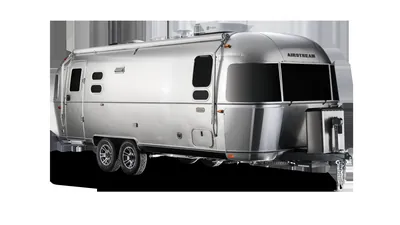
Trade Wind 25FB
26' 2" · 6,300 lb · $139,900
+650 lb+10k+2' long+1 sleeps+6 off-grid
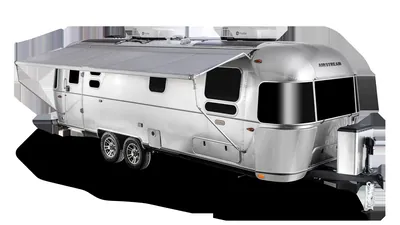
Trade Wind 27FB
28' 2" · 7,025 lb · $155,400
+1,375 lb+26k+4' long+1 sleeps+6 off-grid
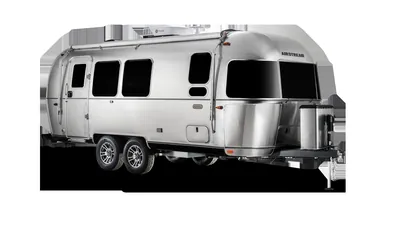
Trade Wind 23FB
23' 11" · 5,650 lb · $129,900
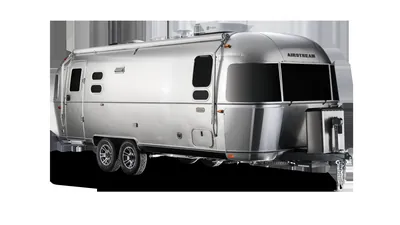
Trade Wind 25FB
26' 2" · 6,300 lb · $139,900
+650 lb+10k+2' long+1 sleeps+6 off-grid
You might also like
Similar specs from other Airstream families
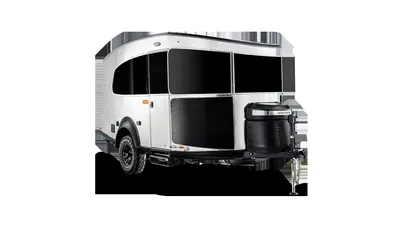
Basecamp Xe 20
20' 2" · 3,750 lb · $84,900
-1,900 lb-45k-4' long
Sleeps 4 · Similar off-grid
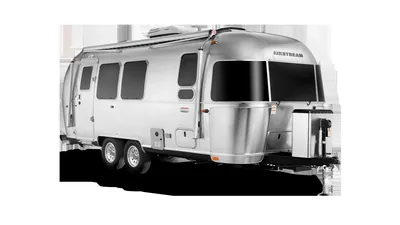
International 23FB
23' 11" · 5,100 lb · $121,400
-550 lb-8k-30 off-grid
Sleeps 4 · Similar weight
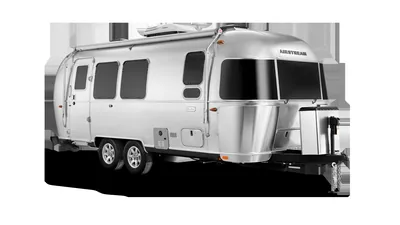
Flying Cloud 23FB
23' 11" · 5,000 lb · $106,400
-650 lb-23k-30 off-grid
Sleeps 4 · Similar weight
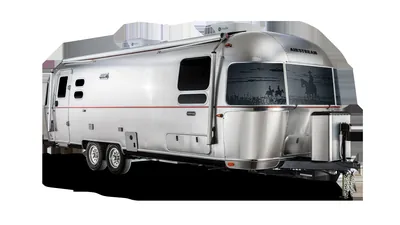
Stetson + 6666 Special Edition 27FB
28' 2" · 6,700 lb · $171,900
+1,050 lb+42k+4' long-29 off-grid
Sleeps 4